

Search results

    Search results

    Show all results for ""
    Can not find any results or suggestions for ""

    Search tips

    • Make sure there are no spelling errors
    • Try different search terms or synonyms
    • Narrow your search for more hits

    How can we help?

    Contact Us

    Find Employees

    University of Skövde, link to startpage

    Search results

      Search results

      Show all results for ""
      Can not find any results or suggestions for ""

      Search tips

      • Make sure there are no spelling errors
      • Try different search terms or synonyms
      • Narrow your search for more hits

      How can we help?

      Contact Us

      Find Employees

      University of Skövde, link to startpage

      Cognitive Neuroscience: Mind and Brain - Master's Programme

      Programme, Master's (2nd cycle), 60 credits, MEDHA
      Degree of Master

      Cognitive Neuroscience: Mind and Brain - Master's Programme

      Programme, Master's (2nd cycle), 60 credits, MEDHA
      Degree of Master

      Application

      Choose a programme instance to display its syllabus, courses and entry requirements

      Autumn 2026, Location: Campus (Skövde), Pace: 100%

      Application closed

      Application

      16 October 2025 - 15 January 2026

      Application code HS-41287 at universityadmissions.se

      Programme Syllabus

      When? Where? How?

      Study period: 31 August 2026 - 6 June 2027
      Location: Skövde, Campus
      Pace of study: 100%

      Courses (syllabus)

      Find the complete course list in the programme syllabus.

      Admission Requirements

      Admission requires at least a Bachelor's Degree (equivalent to a Swedish Bachelor’s Degree) in Cognitive Neuroscience or equivalent.

      A further requirement is proof of skills in English, equivalent of studies at upper secondary level in Sweden, known as English 6 or English level 2. This is normally demonstrated by means of an internationally recognized test, e.g., IELTS, TOEFL, or an equivalent.

      Tuition fee

      Total 155,000 SEK (first instalment 77,500 SEK)
      EU/EEA Citizens are not required to pay tuition fees.
      Selection

      Credits awarded.

      Language

      The courses are conducted in English.

      Autumn 2027, Location: Campus (Skövde), Pace: 100%

      Application

      16 October 2026 - 15 January 2027

      Application code HS-41312 at universityadmissions.se

      Programme Syllabus

      When? Where? How?

      Study period: 30 August 2027 - 4 June 2028
      Location: Skövde, Campus
      Pace of study: 100%

      Courses (syllabus)

      Find the complete course list in the programme syllabus.

      Admission Requirements

      Admission requires at least a Bachelor's Degree (equivalent to a Swedish Bachelor’s Degree) in Cognitive Neuroscience, Neuroscience, Psychology or Cognitive Science, or closely related fileds.

      A further requirement is proof of skills in English, equivalent of studies at upper secondary level in Sweden, known as English 6 or English level 2. This is normally demonstrated by means of an internationally recognized test, e.g., IELTS, TOEFL, or an equivalent.

      Tuition fee

      Total 155,000 SEK (first instalment 77,500 SEK)
      EU/EEA Citizens are not required to pay tuition fees.

      Selection

      Credits awarded.

      Language

      The courses are conducted in English.

      Are you fascinated by the relationship between the mind and the brain? Do you want to understand how neural activity gives rise to mental processes, and develop the critical skills to evaluate the science behind it? Our English-language Master's programme in Cognitive Neuroscience: Mind and Brain offers you the opportunity to explore these profound questions at the highest academic level, equipping you with the knowledge and expertise to push the boundaries of what we know about the human mind.

      About the programme

      The University of Skövde offers a one-year Master’s programme in Cognitive Neuroscience: Mind and Brain, taught entirely in English. Uniquely, it is the only Master’s -level programme in cognitive neuroscience available in Sweden. Designed for students with a background in cognitive neuroscience, neuroscience, psychology, or cognitive science, or in closely related fields, this rigorous 60-credit programme spans two consecutive semesters of focused, intensive study, and corresponds to a Swedish “magisterexamen”. The programme provides a strong foundation for advanced studies at the research level in the subject area.

      Opportunities for further studies

      The programme began in 2011 and has achieved strong academic standing. After graduating, many of our students have continued their studies at second- or third-cycle level at various universities, both in Sweden and abroad, including but not limited to Karolinska Institute, Linköping University, Max Planck Society, University College London, KU Leuven, the École Normale Supérieure, and the University of Bern.

      Application period

      International students apply during the international application period. Students from Sweden can apply additionally during the national application period.
      Check universityadmissions.se for more detailed information.

      Research

      Many members of the staff at the department carry out active research, in some cases as part of major research projects and with international collaborators. 

      Our research group integrates philosophical inquiry with the scientific study of mind, brain, and behavior to better understand consciousness, cognition, and well-being. 

      Our research topics cover altered states of consciousness such as sleep, anesthesia, dreams, and hypnosis, along with topics like embodiment and agency, subjective well-being and mental health, empathy, ethics, attention, visual perception, and cognition more broadly.

      To find out more about this research, check the research pages of the Cognitive Neuroscience and Philosophy Research Group.

      Films about Cognitive neuroscience

      Programme film Cognitive Neuroscience: Mind and Brain
      1 / 2
      Programme film Cognitive Neuroscience: Mind and Brain
      Cognitive Neuroscience - EEG and VR Lab

      Constituent courses in the study programme

      During the first semester, you will study four courses within different subjects:

      The courses comprise lectures, seminars, workshops and group discussions. The focus lies on a critical evaluation of the current assumptions and approaches in cognitive neuroscience. Several of the courses are given by internationally leading researchers at the department.

      During the second semester, you will carry out an empirical or theoretical thesis project within cognitive neuroscience, either in our own lab facilities or with one of our affiliated research groups. During the semester, you will receive personal supervision from an experienced member of the teaching staff in your work.

      Some students utilise an opportunity to write their thesis at other institutions in Sweden or even outside Sweden. We are in contact, both nationally and internationally, with other research groups which may offer an opportunity for a degree project.

      FAQs

      If you have more questions about how to apply and how the program works, see our FAQ which addresses some of the most common questions we get.

      If there are general questions about admissions or studies which are not addressed here, you can get in touch with our Study counsellor Ingrid Christensson.

      If there are questions about teaching, research, or content of the programme, you can contact our Programme Coordinator Katja Valli.

      Admissions

      You  need to apply via UniversityAdmissions.se. The admissions procedure for the entire country of Sweden is administered centrally at a national level, via UniversityAdmissions.se. Applications to our programme, like applications to any other university study programme in Sweden, are submitted via their website, and via their website only.

      International students must apply via the international admissions round. The deadline for this is typically in Mid-January. National (Swedish) students can apply in both the international and the national admission rounds (the latter is typically later, Mid-April).

      For all questions relating to the overall general admissions procedure, such as deadlines and similar, please see the information and contact details available at UniversityAdmissions.se. You can also check the How to apply overview from the University.

      University Admissions will first check that your degree qualifies for further studies in Sweden and calculates a merit rating based on your previous degree and course work. Then, your application will be scrutinized by us to assess whether your background is suitable for studies in Cognitive Neuroscience. We typically admit students from many different academic backgrounds (and not only with a background in Cognitive Neuroscience).

      Please note that we (Program director, Admissions) cannot provide you with any information about your chances of being admitted or your prospective merit rating (that is done by University Admissions).

      No. As noted above, the admissions procedure for the entire country of Sweden is administered centrally at a national level, via UniversityAdmissions.se. Once they have performed a preliminary assessment of your application and deemed that it meets the general entry requirements, they will forward your application documents to us, and we will evaluate the suitability of your background to undertake studies in Cognitive Neuroscience.

      After we receive your application, we may be in contact with you to request further specifications, when we deem this to be necessary. Without having seen all your application documents (i.e., the application passed by University Admissions), any information on your chances of being admitted is only preliminary and without any guarantee.

      You have to provide proof of skills in English equivalent to studies at upper secondary level in Sweden, known as English course 6 / English B. This is normally demonstrated by means of an internationally recognized test, e. g., IELTS, TOEFL, or equivalent.

      Success in your studies with us, however, requires a reasonably high level of comprehension of academic English, which is arguably higher than the formal requirements. Although we do not test for this, it is important to be aware of the following prior to applying.

      To a large extent, the programme centers around reading and engaging with original, English-language, published research in cognitive neuroscience and adjacent fields, and so it is critical that you have the capacity to work with such literature. If you are in doubt, have a look at some of the free articles in, e. g., the Journal of Cognitive Neuroscience; this is the sort of material you will largely be focusing on during the programme.

      Yes, we are happy to receive applications from anywhere in the world. However, if you do not hold EU or EEA citizenship, then you will be liable for tuition fees.

      The university has a limited number of scholarships available for non-EU/EEA students to help offset a proportion of the tuition fees. Please see the university scholarships page.

      Apart from the university scholarships, most of which only offset a portion of the tuition fees for non-EU/EEA students liable to pay them (see the previous question), we do not have any programme-specific scholarships available from the university.

      Although varying from year to year, and eligibility varying from country to country, the Swedish Institute sometimes offers a limited number of scholarships, which typically cover tuition fees, a living stipend, and travel costs up to a stipulated amount. For more information, see the scholarship information on the Swedish Institute's website. Unfortunately, we cannot answer questions about these particular scholarships, as we are not involved in processing applications for them.

      Apart from the above options, your best chance of receiving a scholarship is probably by applying to relevant institutions in your home country.

      No, the programme is only given as a one-year, fulltime, campus-based programme. Thus, attendance in lectures, seminars, and practical workshops is expected.

      No, the programme only admits new students for the autumn term intake. Therefore, it is very important to check deadlines and the application procedure in advance. If your application was not submitted via University Admissions in time, we cannot include your application in our programme-specific assessment.

      Studying the programme

      Every year we typically admit about 12-16 students. Some of those students come from our own undergraduate programme in cognitive neuroscience, while the other students typically come from outside Skövde or Sweden. On average, 30-70% of our students are international. Our student group therefore consists of people with different backgrounds, academically as well as personally. In the autumn term, you will interact in particular with 3-4 of our lecturers and work intensively with them.

      Throughout the programme, we cultivate a critical and analytical approach to cognitive neuroscience. Students are trained to examine how methodological choices shape experimental outcomes and, in turn, influence our understanding of brain function. We believe that this kind of rigorous, questioning mindset is not just valuable but it is essential for anyone seeking to meaningfully advance our understanding of the brain-mind relationship.

      The programme courses are examined and graded in a variety of ways, ranging from written or oral examinations, through quizzes and presentations to practical skill tests and essays. Although there is some variation from course to course, expect a particular emphasis on formal presentations and written essays. Our admitted students are expected to have a grasp of the basics when it comes to both presentations and essays, so if this has not been a component of your undergraduate studies, then you may need to spend some extra time brushing up on the relevant skills prior to commencing the programme. For further information, you can look into the guidelines for academic writing/skills of the American Psychological Association, which we typically use in our work.

      Many areas of research within cognitive neuroscience have direct or potential applications in clinical settings, but our programme does not have a clinical focus. Our programme emphasises developing general experimental and research skills in cognitive neuroscience, and understanding its philosophical background assumptions. You are, of course, welcome to apply even if your prior studies or career were clinically focused, and it may be that you benefit greatly from the programme for subsequent clinical studies, but there is no explicit clinical emphasis or training during the programme itself.

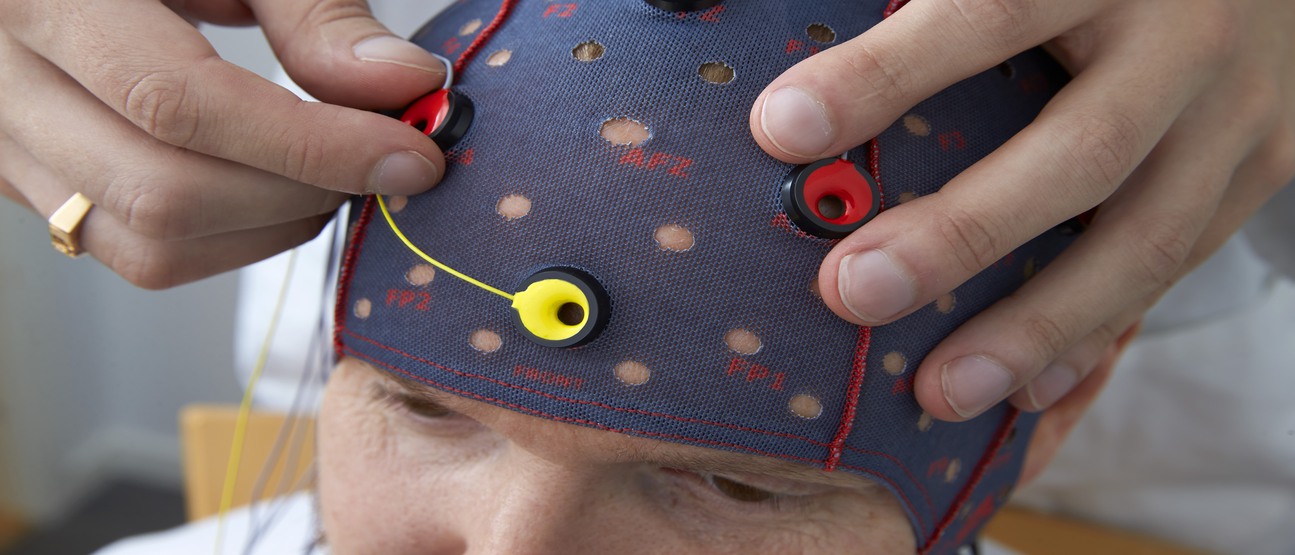
      The programme includes hands-on coursework experience in our psychophysiology lab (using techniques such as EEG, ERP, HRV, skin conductance, VR, and motion tracking). You will gain hands-on experience in setting up and conducting an EEG experiment, and will be trained on how to conduct body illusion experiments, either manually or through virtual reality. We can also measure heart rate to assess physiological parameters (e.g., HRV) during behavioural experiments, or utilise a virtual reality platform that includes whole-body motion and eye-tracking.

      You will have access to the laboratory throughout your studies and can use the whole range of equipment for your thesis project.

      No, in fact, we recommend that you familiarise yourself with a number of potential topics and supervisors during the autumn term, prior to deciding a topic (together with your supervisor) at the beginning of the subsequent spring term.

      If you intend to write the thesis with someone from our department, you can propose an experimental or theoretical topic or join a running project. Of course, your project needs to be within the scope of one of our potential supervisors. The thesis can be experimental (e.g., run an EEG experiment or a behavioural study in VR), a systematic review on a relevant topic, or a theoretical article, or a philosophical evaluation of a research question. The thesis topic must qualify within cognitive neuroscience, however.

      If you aim for an experimental study, you can fully utilize our laboratory and its equipment. Find our latest publications to get an idea of what kind of research our department is doing. In the DiVA Portal you can also find some examples of theses from previous years.

      Notably, a small number of our thesis projects have eventually resulted in publications, and we encourage our students to join our research projects and produce new and original research when possible.

      If your interest is outside the scope of our department’s expertise, you may want to consider joining a different laboratory or group. If you intend to write your thesis outside the department (or even outside of Sweden), of course it is recommended to initiate the contact to this lab as soon as possible. As stated earlier, we may be able to help you to get in touch with other principal investigators. However, the responsibility to initiate and discuss such an arrangement is with you.

      The programme is also part of the Federation of European Neuroscience Societies (FENS) Schools Network, which offers stipends to go for lab visits to other FENS affiliated schools. Please check fens.org for further information.

      Further, there are also opportunities to apply for stipends to go abroad for a shorter duration. However, such a plan would have to be initiated as early as possible. If you want to understand what kind of options there are, please get in touch with our international office.

      The University provides support for students with learning difficulties such as dyslexia or ADHD (and other forms of disabilities). In this case you have to get in touch with our student support. In this process you may have to provide further documents. Once our student support has checked your case and recommends specific educational support, certain arrangements to your study plan can be made.

      It is your responsibility to initiate this process in due time. Once you have been granted this support, it is your responsibility to approach lecturers as early as possible to discuss how we can adjust for example deadlines or other aspects of the courses to fit your situation. This has to be discussed on a case-by-case basis.

      Please be aware that this is a one-year program and all courses take place only once a year, thus requiring focused study and a relatively high work pace. If the time frame cannot accommodate the specific adjustments required for you, it may eventually result in the need to extend your study to the following year. These aspects have to be considered when planning your study with us. Also, consult our student counsellor, who can provide help when planning your individual study plan.

      Living in Skövde

      There is no formal requirement that you must reside in Skövde, during term or otherwise. You will, however, be expected to be in Skövde for a number of occasions - lectures, seminars, workshops, presentations, exams, etc. Depending on the time of the term, this may vary from several times a week, to only once every couple of weeks. It is up to you to determine from how far away you are comfortable commuting, should you consider such an option.

      If you are coming from outside Sweden, please consider that travel arrangements have to be made in advance, and that you need to be in Skövde no later than two weeks after the start of the term. If you do not show up for the registration by the deadline, you may lose your place.

      If you come from outside the EU, please note that the program coordinator cannot provide answers to questions like VISAs or residence permits, or similar issues. Also, the university can do only little when it comes to these legal procedures, and you have to check with the respective authorities to resolve these issues. You can contact our international office who may be able to provide some guidance.

      Yes, you can, but please note that you will probably not be eligible for standard student housing if you do. In particular, our student housing landlords will not permit children in the student flats. Therefore, if you intend to come with a partner, any children, and/or any other family members, then it is absolutely imperative that you contact the university accommodation office as soon as possible, so that you aren't denied housing altogether.

      Our university accommodation office can help give you relevant information (contacts, etc.). Please bear in mind that, unlike many other countries, it is relatively unusual to find furnished flats to rent in Sweden. If you are planning to sort your own accommodation, then be prepared either to bring or to buy all the home essentials: furniture, cutlery and crockery, etc. (Rented flats normally come with white goods - a fridge and freezer, and possibly a dishwasher - and, typically, access to shared laundry facilities).

      Although there is no formal restriction on extra-curricular employment, we strongly recommend against it, since the amount of effort required to successfully complete the programme entails a significant undertaking - in our experience thus far, students who attempt to work while studying the programme tend to never finish. In addition, you should be aware that it can be very difficult to find paid employment in Skövde and the surrounding region, particularly if you do not already speak Swedish relatively fluently.

      Although Sweden has a historical reputation as a relatively expensive country, it is no longer particularly so, when compared to many other Western European countries. More information can be found at studyinsweden.se.

      Contact

      Programme co-ordinator

      Study and Career Counsellor

      Want to know more about the programme?

      The University of Skövde will only use the information you submit via the form for this specific purpose, which is to ensure that you receive relevant information based on your area of studies. For more information on how we process your personal data, please see www.his.se/en/dataprivacy

      Published: 4/24/2020
      Edited: 10/12/2023
      Responsible: webmaster@his.se