Search results

    Search results

    Show all results for ""
    Can not find any results or suggestions for ""

    Search tips

    • Make sure there are no spelling errors
    • Try different search terms or synonyms
    • Narrow your search for more hits

    How can we help?

    Contact Us

    Find Employees

    University of Skövde, link to startpage

    Search results

      Search results

      Show all results for ""
      Can not find any results or suggestions for ""

      Search tips

      • Make sure there are no spelling errors
      • Try different search terms or synonyms
      • Narrow your search for more hits

      How can we help?

      Contact Us

      Find Employees

      University of Skövde, link to startpage

      Bachelor of Science in Engineering – Industrial Informatics

      Programme, Bachelor's (1st cycle), 180 credits, HINDG

      Bachelor of Science in Engineering – Industrial Informatics

      Programme, Bachelor's (1st cycle), 180 credits, HINDG

      Application

      Choose a programme instance to display its syllabus, courses and entry requirements

      Autumn 2027, Location: Campus (Skövde), Pace: 100%

      Application

      16 October 2026 - 15 January 2027

      Application code HS-71239 at universityadmissions.se

      Programme Syllabus

      When? Where? How?

      Study period: 30 August 2027 - 9 June 2030
      Location: Skövde, Campus
      Pace of study: 100%

      Courses (syllabus)

      Find the complete course list in the programme syllabus.

      Admission Requirements

      General entry requirements.
      Further requirements: Physics 2, Chemistry 1, Mathematics 3c or Mathematics D or Physics level 2, Chemistry level 1, Mathematics Further level 1c (or the equivalent).

      A further requirement is proof of skills in English equivalent of studies at upper secondary level in Sweden, known as English course 6 or English level 2 (or equivalent). This is normally demonstrated by means of an internationally recognized test, e.g. IELTS, TOEFL or the equivalent.

      Tuition fee

      Total 465,000 SEK (first instalment 77,500 SEK)
      EU/EEA Citizens are not required to pay tuition fees.

      Selection

      Grade 67%, Swedish Scholastic Aptitude Test 33%.

      Language

      The courses are conducted in English.

      Would you like to become an engineer who leads industry’s digital revolution? The international three-year Bachelor of Science in Engineering programme in Industrial Informatics is a unique interdisciplinary programme combining information technology, mechanical engineering and electrical engineering. You will gain the knowledge needed to develop, integrate and apply digital technologies in the industry of the future.

      About the programme

      Modern industry is undergoing rapid digital transformation. Smart Manufacturing and Industry 4.0 and 5.0 are changing the way companies develop, manufacture and monitor production processes. Machines, robots, sensors and control systems are being connected, generating large volumes of data.

      Industry therefore needs engineers who understand both physical manufacturing and the digital systems behind it. You will study programming, automation, production engineering, Industrial IoT (Internet of Things), databases and data-driven methods. At the same time, you will gain a solid engineering foundation in mathematics, electrical engineering and industrial production systems. The combination of courses will enable you to understand both the machines and the systems used to control, monitor and analyse production processes.

      The programme is a complete three-year degree programme that can also serve as the first stage of a five-year (3+2-year) pathway leading to a Master’s degree in Industrial Informatics.

      The University of Skövde has developed both this Bachelor of Science in Engineering programme and the subsequent Master’s Programme in Industrial Informatics in close collaboration with global companies such as Volvo Group, Volvo Cars, ABB, Aurobay, GKN Aerospace and Virtual Manufacturing. Their skill requirements have influenced the content of the programmes, ensuring that you gain knowledge that is in demand in future industry.

      Career

      Industry has a strong demand for expertise in digitalisation, automation and smart manufacturing, and this programme will make you an attractive candidate on the labour market. After graduation, you could, for example, work as:

      • Industrial Data Analyst: analysing production and operational data
      • Digital Twin Engineer: developing digital representations of products, processes, and production systems
      • Industrial IoT Engineer: connecting machines, sensors, cloud platforms, and industrial information systems
      • Autonomous Systems Engineer: responsible for industrial systems that sense conditions, make decisions, coordinate resources, and adapt their operation
      • Industrial Systems Architect: designs how machines, software, data, people, AI, and enterprise systems work together across an industrial operation

      You will be in contact with industry throughout the programme. In several semester projects, you will work on assignments together with our partner companies. This gives you experience of real-world technical challenges and the opportunity to build a professional network while you are still studying.

      The focus of your studies

      You will study on campus in Skövde, where you will begin working on practical solutions at an early stage, often in teams with other students and in close collaboration with industry.

      The programme is based on the CDIO framework: Conceive, Design, Implement, Operate. You will learn about the entire development process, from identifying a problem to designing, implementing, testing and deploying a solution.

      Year 1

      In the first year, you will build a foundation in mathematics, programming, production systems and the role of people in production. This includes programming logic, mathematical modelling and the interaction between people and technology.

      Year 2

      In the second year, you will deepen your knowledge of mechanical engineering, mathematics and information technology. Courses include mechanics, materials and manufacturing engineering, database systems, mathematical statistics, data-driven artificial intelligence and industrial programming.

      In the semester project, you and your fellow students will combine knowledge from several subject areas to develop solutions for industrial production processes.

      Year 3

      In the third year, you will develop specialist expertise in industrial digitalisation and smart manufacturing. The content includes sensors and data acquisition, IoT, distributed systems, robotics, quality management, artificial intelligence and production systems development. You will also study project management and technical leadership.

      The programme concludes with a 15-credit degree project in which you solve a real-world technical problem, often in collaboration with an industrial company or a research environment.

      Teaching

      The semester projects bring together several courses and allow you to move from theory to working solutions as part of a team, in a way that resembles development projects in industry.

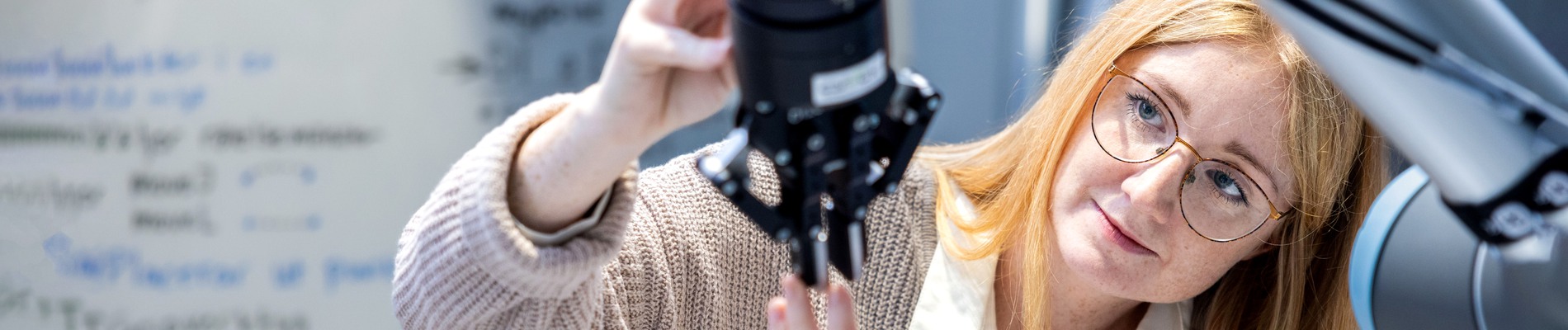
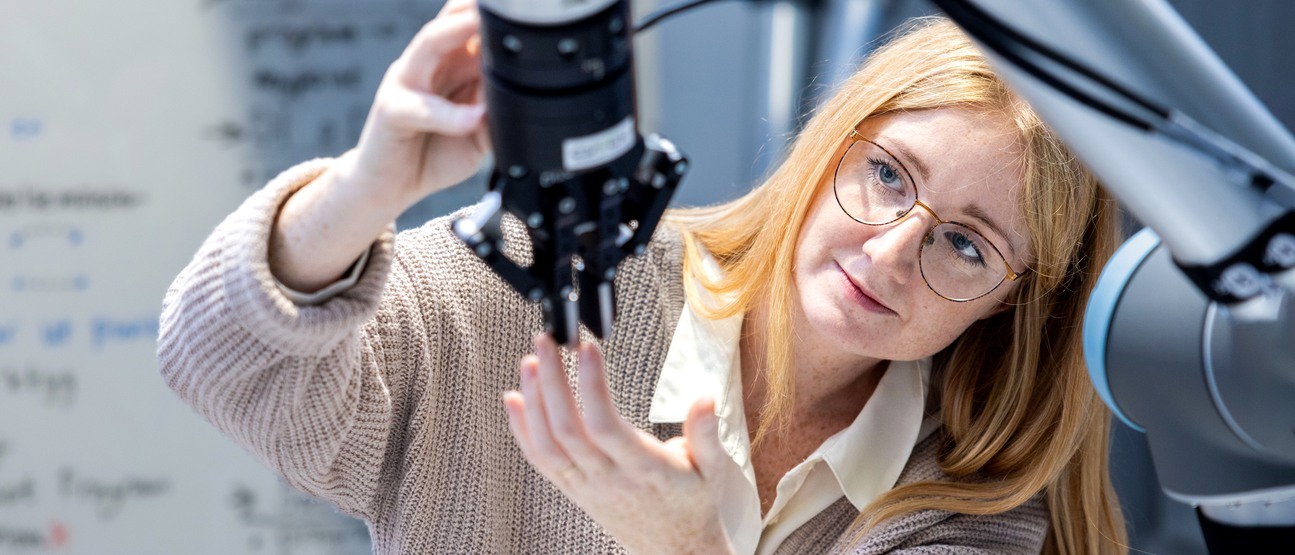
      Part of the programme takes place at ASSAR Industrial Innovation Arena, where industry and academia come together. Facilities include robot cells, CT scanning (3D computed tomography) and digital twins.

      International profile

      All teaching and course literature are in English. Studying together with students from different parts of the world gives you experience of international collaboration – valuable in a global industry.

      Further studies

      After three years, you will graduate with a Degree of Bachelor of Science in Engineering and can enter the global labour market directly. Another option is to continue within industrial informatics by completing our two-year Master's Programme in Industrial Informatics (120 credits), to which you are given priority admission. Thus you can earn a Master's degree and gain advanced expertise after a total of five years of study.

      You can also continue your master’s studies at other higher education institutions in Sweden or abroad.

      Research

      The programme has strong links to the University’s research in engineering science and information technology. The lecturers are active researchers and bring current knowledge into the programme in areas including optimisation, Virtual Commissioning and machine learning.

      Study abroad

      Spending a semester abroad or completing your degree project with an international partner gives you valuable international experience. Our international hubs are located in Thailand, Brazil and the United States. Here you will be able to get the most out of your semester abroad by combining your studies with an internship in industry. If you want to do your semester abroad in a different country, that can be arranged as well.

      This way, you will also build an international network in preparation for a career in a global industry.

      Questions and Answers

      Compared with computer engineering and computer science:
      While computer engineering primarily focuses on algorithms, data structures, hardware, operating systems and general software development in digital environments, industrial informatics applies these IT methods directly to physical and mechanical manufacturing processes. Software used in industrial informatics must operate under strict real-time requirements with a high degree of reliability, take physical machine constraints into account (mechanical engineering) and be controlled safely via industrial networks and sensor networks (electrical engineering).

      Compared with traditional informatics and information systems, which have a social science orientation:
      Information systems and traditional informatics study information systems from organisational, administrative or behavioural science perspectives. Industrial informatics, by contrast, is a purely technical and engineering discipline in which algorithms, applied AI and control engineering directly control physical production lines and robots.

      Compared with traditional production engineering and automation: Traditional production engineering often focuses on individual machines, mechanics or local PLC programming. Industrial informatics takes this to a system-of-systems level by connecting the entire manufacturing chain using industrial IoT, cloud architectures, applied AI and digital twins.

      The programme is campus-based in Skövde and offers a balanced combination of lectures, seminars, problem-solving sessions, computer laboratory work and practical projects. The approach to learning follows the international CDIO framework (Conceive, Design, Implement, Operate), which means that you gain experience of the entire development process, from ideas and theoretical modelling to programming, testing and physical or virtual deployment.

      A typical semester is divided into two study periods, during which you normally take two courses in parallel. A central theme running throughout the programme is the integrated semester projects, in which groups of students combine knowledge from all the courses taken during the semester to solve a real-world industrial problem. Practical laboratory work is carried out at ASSAR Industrial Innovation Arena, a high-tech collaborative environment equipped with industrial robots, collaborative robots (cobots), AGVs, AI vision systems, CT scanners and digital twins.

      There is very strong demand for engineers with this distinctive combination of skills, people who understand both physical manufacturing processes and the digital networks and algorithms behind modern production systems. After graduation, you can work in roles such as:

      • Automation engineer specialising in robotics and industrial control systems
      • IoT developer and systems integrator (industrial IoT, sensor networks and connected factories)
      • Production or digitalisation engineer (optimisation of manufacturing flows, quality management and applied AI)
      • Maintenance engineer specialising in data analysis and predictive maintenance
      • Industrial IT consultant or project manager for technological transformation and Industry 4.0/5.0 projects

      Potential employers include global companies in the manufacturing and automotive engineering industries, IT and engineering consultancies, and emerging digitalised industries, for example Volvo Group, Volvo Cars, ABB, GKN Aerospace, SSAB, Capgemini and Virtual Manufacturing.

      The Bachelor of Science in Engineering degree (180 credits) also gives you direct eligibility for the two-year Master’s Programme in Industrial Informatics (120 credits), which can prepare you for more research-oriented or senior positions. After completing this Bachelor of Science in Engineering programme, you will have priority admission to the Master’s programme.

      Collaboration with industry is integrated throughout the programme:

      • Industry-based semester projects: From the first year onwards, project assignments and problem statements for the semester projects are based on real-world industrial challenges.
      • ASSAR Industrial Innovation Arena: Through teaching and laboratory work at ASSAR, you will work in an environment where researchers, students and industry partners, such as Volvo, ABB and IDC, meet on a daily basis.
      • Guest lectures and study visits: The programme includes regular study visits to modern manufacturing environments as well as guest lectures by experts working at leading industrial companies.
      • Industry-based projects and degree project: During the final year, you will complete your degree project as well as industry-based project courses in direct collaboration with a company, where you will tackle real-world technical challenges on site.
      • Industry events: You will have regular opportunities to build your professional network through lunchtime seminars, networking events and events such as the annual Production Engineering Day at ASSAR.
      • A semester abroad: if you study at one of our international hubs you will be able to combine your studies with an industrial internship.

      Contact

      Programme co-ordinator

      Programme co-ordinator

      Study and Career Counsellor

      Want to know more about the programme?

      The University of Skövde will only use the information you submit via the form for this specific purpose, which is to ensure that you receive relevant information based on your area of studies. For more information on how we process your personal data, please see www.his.se/en/dataprivacy

      Published: 9/17/2026
      Edited: 9/17/2026
      Responsible: webmaster@his.se