Search results

    Search results

    Show all results for ""
    Can not find any results or suggestions for ""

    Search tips

    • Make sure there are no spelling errors
    • Try different search terms or synonyms
    • Narrow your search for more hits

    How can we help?

    Contact Us

    Find Employees

    University of Skövde, link to startpage

    Search results

      Search results

      Show all results for ""
      Can not find any results or suggestions for ""

      Search tips

      • Make sure there are no spelling errors
      • Try different search terms or synonyms
      • Narrow your search for more hits

      How can we help?

      Contact Us

      Find Employees

      University of Skövde, link to startpage

      Industrial Informatics - Master's Programme

      Programme, Master's (2nd cycle), 120 credits, INDMA

      Industrial Informatics - Master's Programme

      Programme, Master's (2nd cycle), 120 credits, INDMA

      Application

      Choose a programme instance to display its syllabus, courses and entry requirements

      Autumn 2027, Location: Campus (Skövde), Pace: 100%

      Application

      16 October 2026 - 15 January 2027

      Application code HS-41320 at universityadmissions.se

      Programme Syllabus

      When? Where? How?

      Study period: 30 August 2027 - 3 June 2029
      Location: Skövde, Campus
      Pace of study: 100%

      Courses (syllabus)

      Find the complete course list in the programme syllabus.

      Admission Requirements

      A Bachelor’s degree equivalent to a Swedish Kandidatexamen of 180 credits with a major within the main field of industrial informatics, mechanical engineering, production engineering, automation engineering, electrical engineering, computer engineering, information technology (or the equivalent).

      Additionally 22.5 credits are required in mathematics, including single-variable and multivariable calculus, linear algebra and mathematical statistics. In addition, at least 7.5 credits in programming and 7.5 credits in AI, machine learning or data-driven analysis are required.

      A further requirement is proof of skills in English equivalent of studies at upper secondary level in Sweden, known as English course 6 or English level 2 (or equivalent). This is normally demonstrated by means of an internationally recognized test, e.g. IELTS, TOEFL or the equivalent.

      Tuition fee

      Total 310,000 SEK (first instalment 77,500 SEK)
      EU/EEA Citizens are not required to pay tuition fees.

      Selection

      Credits awarded.

      Language

      The courses are conducted in English.

      Do you want to combine artificial intelligence, smart manufacturing and advanced engineering to shape the factories of the future? The Master’s Programme in Industrial Informatics at the University of Skövde prepares you to design, optimise and manage intelligent production systems using industrial AI, cyber-physical systems, data analytics and digital technologies. Through close collaboration with industry and research, you develop the knowledge and skills needed for advanced engineering roles in manufacturing, automation and digital transformation.

      About the programme

      Manufacturing industry is undergoing a profound transformation driven by the concepts of Industry 4.0 and Industry 5.0. Modern production relies on cyber-physical systems, Internet of Things (IoT), cloud-based architectures and advanced data analytics. This international two-year master’s programme provides the theoretical knowledge and practical engineering skills needed to design, optimise and manage complex, integrated production systems.

      The programme has been developed with leading industrial companies, including Volvo Group, Volvo Cars, ABB, SSAB, GKN Aerospace and Boliden, helping ensure that graduates gain competencies sought after nationally and internationally.

      Career opportunities

      Graduates are prepared for advanced engineering and specialist roles in manufacturing, technology and consultancy worldwide, including:

      • Industrial AI Specialist
      • Robotics and Autonomous Systems Engineer
      • Smart Factory Engineer
      • Automation Systems Architect
      • Cyber-Physical Systems Engineer
      • Research and Development (R&D) Engineer

      The focus of your studies

      The curriculum focuses on advanced modelling, simulation and data-driven artificial intelligence for smart manufacturing.

      Year 1

      You build a foundation in advanced engineering methods, scientific principles and data-driven manufacturing, including cyber-physical manufacturing, research methodology, process mining, data collection and artificial intelligence.

      What you will study

      Courses such as Cyber-Physical Manufacturing, Research Methods in Industrial Informatics, Simulation and Optimization for Decision Support, and Process Mining for Manufacturing Processes teach you to turn operational data into strong decision support and to model, predict and optimise complex production flows at a holistic system level.

      How you will learn

      Research-connected, problem-based teaching combines optimisation and AI theory with hands-on computer labs using research-grade software. In the second semester, the 15-credit Industry-Embedded Project lets you work on-site with a manufacturing enterprise to solve an authentic, high-level engineering challenge.

      What you will gain

      You learn to formulate scientific research questions, select analytical methods and manage complex engineering projects, preparing you for Year 2 while building a professional network in industry.

      Year 2

      You deepen your knowledge of system optimisation, collaborative robotics (cobots) and advanced computer science, culminating in a 30-credit degree project typically carried out with internationally recognised industrial partners or active research groups.

      What you will study

      Through Generative and Physics-Informed AI, Optimization-Driven Design, and Collaborative Robotics (cobots), you learn how physical hardware, physics-based AI models and human factors combine to create autonomous, resilient, human-centric, resource-efficient and sustainable production systems.

      How you will learn

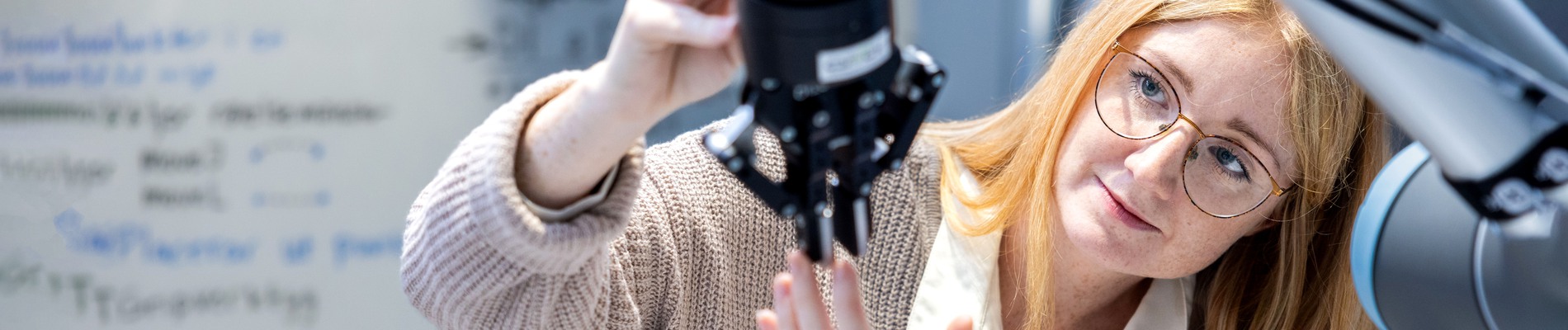
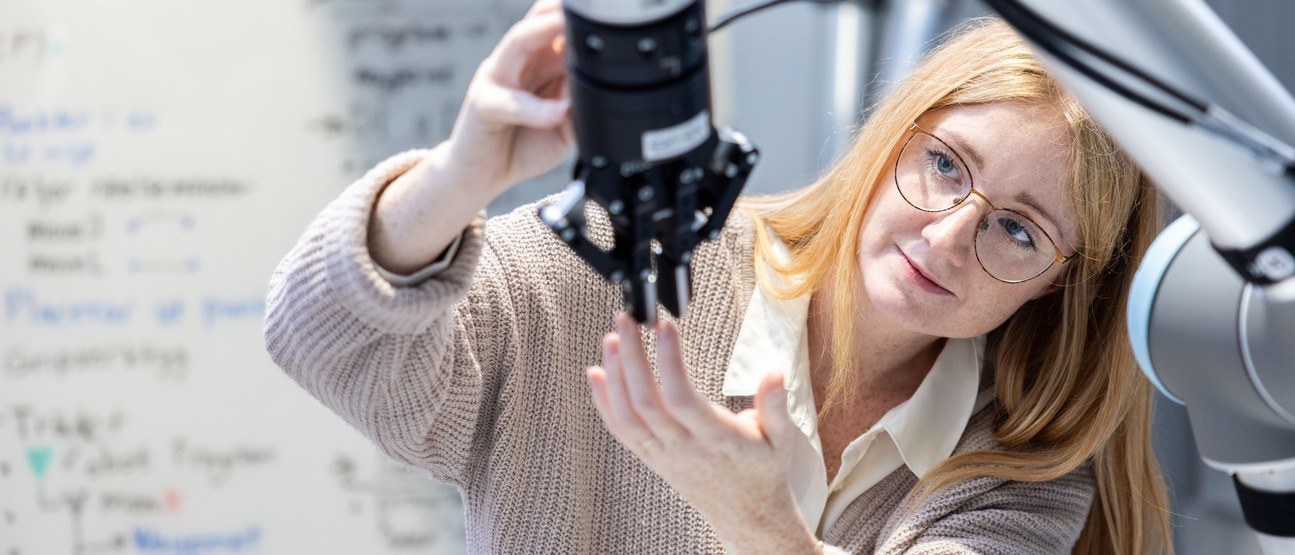
      Courses are integrated with the university's Virtual Engineering and Information Technology research environments. Labs at ASSAR Industrial Innovation Arena use industrial robot cells, digital twins and high-performance computing nodes. The final semester is dedicated to your independent 30-credit Master's Thesis with a global industrial enterprise or active research team.

      What you will gain

      You develop advanced expertise in analysing, designing and improving intelligent manufacturing systems, preparing you for specialist and leadership roles such as Senior Automation Systems Architect, Industrial AI Specialist, Cyber-Physical Systems Engineer or R&D Lead. The degree also provides a strong foundation for doctoral studies (PhD).

      Study abroad

      The international student cohort and English-language curriculum create a multicultural environment. You may complete your degree project or participate in an exchange semester abroad through the university's international partnerships. Research collaborations with the Federal University of Santa Catarina (UFSC), City University of Hong Kong and RWTH Aachen University provide valuable opportunities for international academic engagement.

      Further studies

      A Degree of Master of Science (120 credits) with a major in Industrial Informatics provides a foundation for a research career and fulfils the general entry requirements for third-cycle education in many countries.

      At the University of Skövde, you will be well qualified to apply for research studies within Information Technology, where the School of Engineering Science and the School of Informatics collaborate on advanced smart manufacturing projects. 

      Research

      The programme is linked to the university's Virtual Engineering and Information Technology research environments. Our teaching staff includes professors and senior researchers in areas such as discrete-event simulation, multi-objective optimisation, collaborative robotics and applied artificial intelligence.

      As a master’s student, you have access to high-performance computing infrastructure and research-grade software tools for applying scientific theories to real-world engineering challenges.

      Questions and Answers

      You must hold a bachelor’s degree equivalent to a Swedish Kandidatexamen of 180 credits with a major within the main field of industrial informatics, mechanical engineering, production engineering, automation engineering, electrical engineering, computer engineering, information technology (or the equivalent).

      Additionally 22.5 credits are required in mathematics, including single-variable and multivariable calculus, linear algebra and mathematical statistics. In addition, at least 7.5 credits in programming and 7.5 credits in AI, machine learning or data-driven analysis are required.

      A further requirement is proof of skills in English equivalent of studies at upper secondary level in Sweden, known as English course 6 or English level 2 (or equivalent). This is normally demonstrated by means of an internationally recognized test, e.g. IELTS, TOEFL or the equivalent.

      You need a solid Bachelor's degree background covering calculus, linear algebra, mathematical statistics, and programming experience (e.g., Python, C++, or Java).

      Yes, during Semester 2 you work on an authentic engineering challenge directly with one of our industrial partners (such as Volvo Group, ABB, or GKN) or at ASSAR Industrial Innovation Arena.

      Absolutely. You can choose an industry-partnered thesis or embed within our active research groups (Virtual Engineering and Informatics), supervised by PhD-qualified faculty.

      Physics-Informed AI embeds physical laws directly into neural network training, ensuring AI models in smart manufacturing remain physically accurate and safe when controlling robots or production lines.

      After completing this two-year master’s programme you will be awarded a Degree of Master of Science (120 credits) with a Major in Industrial Informatics, providing eligibility for PhD studies worldwide.

      The programme welcomes both Swedish and international students. It is particularly suitable for students who have completed a Higher Education Diploma in Engineering (180 credits) and wish to continue their studies towards a master's degree in an international learning environment.

      Yes, the University of Skövde offers scholarships and tuition fee waivers for highly qualified students from countries outside the EU/EEA. Scholarship applications are submitted in connection with the admissions process.

      Scholarships and grants

      Contact

      Programme co-ordinator

      Programme co-ordinator

      Study and Career Counsellor

      Want to know more about the programme?

      The University of Skövde will only use the information you submit via the form for this specific purpose, which is to ensure that you receive relevant information based on your area of studies. For more information on how we process your personal data, please see www.his.se/en/dataprivacy

      Published: 9/17/2026
      Edited: 9/17/2026
      Responsible: webmaster@his.se