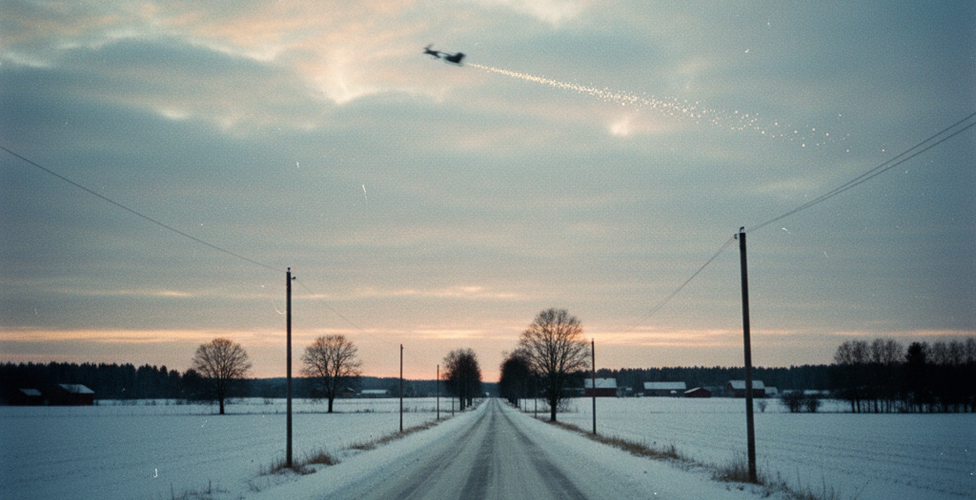
Dad said it was a smudge on the lens, but that glittering trail suggested otherwise. Disposable camera, Hjo, December 1998. Evidence of something grand or just AI?
A Production Engineer’s Worst Nightmare?
Let’s try to think practically. How would all this crafting and packing in Santa’s workshop actually work? Some clues might be found in Disney's animated short film Santa's Workshop, but even the most patient Christmas-present engineer would struggle to keep up with the world's collective wish lists.
Anna Syberfeldt, Professor of Production Engineering, still believes it could be done. If the demand is spread out over the year and production is divided into thousands of self-operating manufacturing cells with full automation and continuous quality control, an unbroken flow chain can be maintained, she explains. A subtle smile crosses Anna’s face.

"With AI support, digital twins and predictive maintenance, it is theoretically possible, but that assumes that flow magic exists and that it is precisely calibrated."
Anna Syberfeldt, Professor of Production Engineering
Probably no mulled wine breaks during delivery
Sandor Ujvari, Senior Lecturer in Logistics, believes that route planning is the major stumbling block. With billions of households, each address must be visited within an extremely narrow time window and in precisely the right order. Otherwise, the whole plan collapses.
"Practically speaking, we’re talking stops that must occur within thousandths of a second. And that’s assuming a perfectly optimised route, with no unnecessary turns or mulled wine breaks. Even a perfectly trained reindeer fleet is a limitation when the timetable requires that kind of precision. But mathematically, it’s possible to calculate," he says.
Okay, so there's a mathematical chance, but then we face the next obstacle. Santa’s presumed gingerbread consumption/weight. A well-planned route may be neatly mapped out, but ultimately, a driver is needed to maintain the pace and morale. Because no matter how we twist and turn tables, time zones and reindeer fleets, it's still a body performing this near-superhuman task, year after year. Is that possible?
Santa's secret – Superfood nutrition
Gianluca Tognon, Senior Lecturer in Public Health Science, furrows his brow and says one cannot overlook the elf factor as a possible explanation for an otherwise biologically hard-to-explain lifestyle. Santa’s physique, he argues, should not be taken as proof against his existence, but rather as a sign of good energy access and care.
"If the elves are skilled cooks, it’s likely that Santa follows a highly nutritious diet, rich in antioxidants from Nordic berries and wild herbs. This superfood diet is crucial for managing the extreme, acute work stress during Christmas Eve," says Gianluca Tognon.
Santa is therefore a learning example of how good food and good company can offset a less-than-ideal lifestyle. His round figure may testify to abundant meals, but doesn’t rule out that they’re full of goodness. Despite his sedentary lifestyle, he manages to pull off his great Christmas Eve feat year after year.
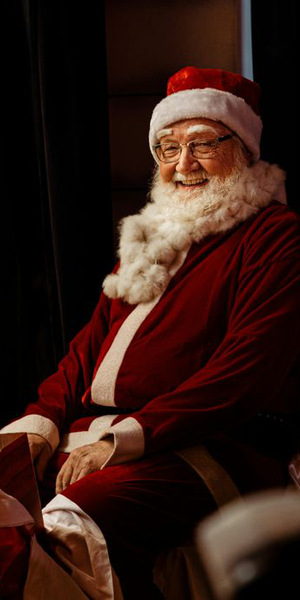
Santa: a silhouette that suggests heavy Christmas snacking, or peak, dietitian-approved fitness?
Possibilities Beyond Numbers
So far, science speaks with some hesitation. Production, logistics and health science suggest that Santa is possible, though hardly proven. But if we now shift perspective and turn to other scientific fields like dreams, consciousness and culture, the question takes flight, yes, it shimmers and gains a different quality. Suddenly, the answer is obvious.
The researchers agree: Santa exists

"Santa exists. At least in dreams if not in waking reality. In dreams, the brain creates a virtual reality simulation that feels completely real when we are having the dream. Thus, when you dream of Santa, the Santa is entirely real to you. Only after you wake up, you realize that Santa may be just a figment of imagination and folklore."
Katja Valli, Professor of Cognitive Neuroscience
From another part of the academic world comes a related thought. Lissa Holloway-Attaway, Associate Professor in Media Arts, Aesthetics and Narration, sees Santa as a story that refuses to end. From farm elf with frost in his beard to global icon with logo status, he has made a remarkable career, carrying traces of folklore, religion and advertising.
"Every new era polishes him a bit, repaints the coat, adjusts the beard and sends him out on a new mission. Strangely, it only makes him more vital. In that sense, Santa exists as a cultural heritage in constant production," she says.
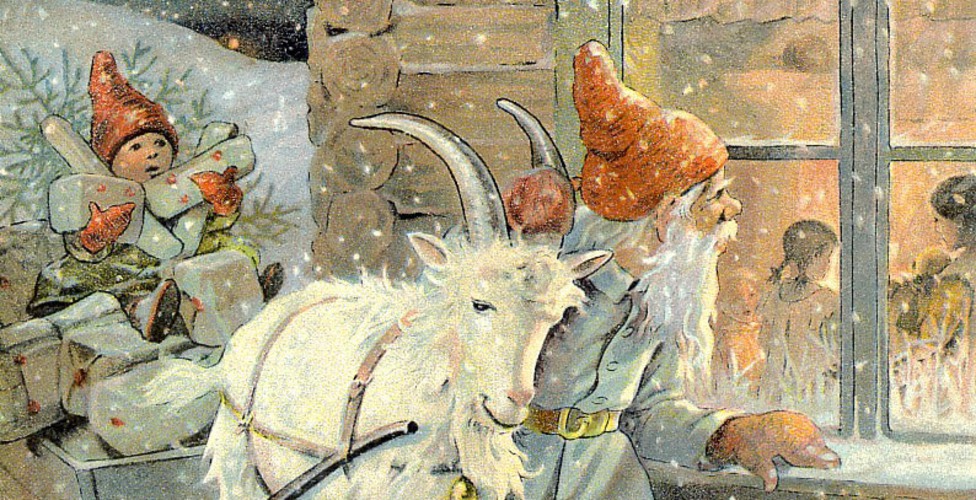
The Swedish Santa, or tomte, the folkloric predecessor to the modern Santa Claus, is, as always, working overtime. Luckily he’s accompanied by the trusty Christmas goat, a guardian spirit in old Nordic tradition, who keeps the journey steady. And as the sleigh glides through the snow, the tomte continues his faithful work of carrying cultural heritage forward. What generations have hauled, sledged and laughed along with finds fresh momentum in Jenny Nyström’s comforting brushstrokes and imagery that have become an indispensable part of Swedish Christmas tradition.
Between formulas and hopes, Santa lives
The conclusion is clear. Santa exists, if only on a conceptual level. With a pinch of goodwill and a trace of Christmas spirit, one could even claim that research leans in that direction, even if reliable reports of an elderly man in a red coat and white beard, soaring behind reindeer, are still conspicuously absent from scientific literature.
Granted, absence of evidence is not evidence of absence, which makes things both tricky and slightly frustrating for those seeking a precise answer. But for now, the question can be considered answered, and with a yes.
And when all is said and done, somewhere between the straight lines of science and the whisper of Christmas night, there is always a sliver of uncertainty. Right there, in the space between knowledge and hope, Santa thrives just fine. At least for everyone not yet nine.
Merry Christmas from the University of Skövde!