Erik Brolin
School of Engineering Science


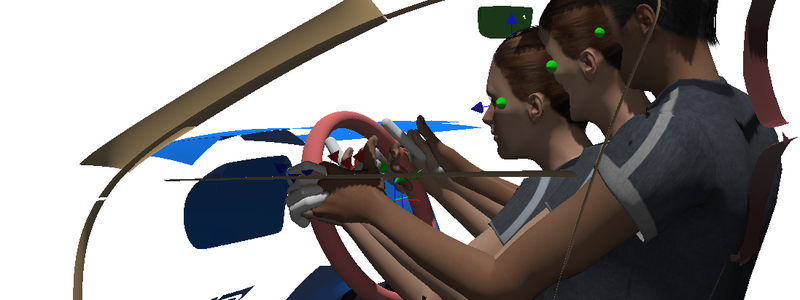
The purpose of the project Automated Design and Optimisation of Vehicle Ergonomics (ADOPTIVE) is to study the physical vehicle user interaction and develop methodology for advanced vehicle ergonomics analyses within simulation tools.
The ADOPTIVE project will focus on the assessment and optimisation of vehicle interior geometries and the user accommodation levels of alternative design solutions. This will be done by enabling fast, objective, and automated simulations of virtual driving test procedures performed by a family of manikins and through subsequent ergonomics evaluations.

This research project has been initiated and designed in close collaboration with product developers working with vehicle ergonomics in the industry. The industrial need is to have more efficient methods and tools to ensure proper ergonomics in future designs of vehicles to benefit product quality aspects such as user diversity considerations, user experience, and active safety.
From an academic point of view, the project contributes to developing knowledge in the area of efficient decision support in virtual engineering design for ergonomics, including successful consideration of user diversity in design processes.
The research findings will be implemented and tested in a digital human modelling (DHM) tool, exemplified by the Swedish DHM tool IPS IMMA (Intelligently Moving Manikins).
The consortium for ADOPTIVE is based on the consortia of previous successful research projects. The previous projects established the foundation for simulations of vehicle ergonomics, and this foundation allows ADOPTIVE to address new research challenges and advance scientific and industrial impacts. Fraunhofer-Chalmers Research Centre for Industrial Mathematics (FCC) will be a research partner on a consultancy basis.
SAFER is the hub for traffic safety research in Sweden. SAFER consists of 30 partners representing stakeholders within the automotive industry, academia and government agencies.

International Journal of Human-Computer Interaction
2026. Article.
https://doi.org/10.1080/10447318.2026.2632154

Digital Human Modeling and Applications in Health, Safety, Ergonomics and Risk Management: 16th International Conference, DHM 2025, Held as Part of the 27th HCI International Conference, HCII 2025, Gothenburg, Sweden, June 22–27, 2025, Proceedings, Part I
2025. Conference paper. https://doi.org/10.1007/978-3-031-93502-2_8
International Journal of Human Factors and Ergonomics
2025. Article.
https://doi.org/10.1504/ijhfe.2025.150419
International Journal of Industrial Ergonomics
2025. Article.
https://doi.org/10.1016/j.ergon.2024.103690
Proceedings of the 21st Congress of the International Ergonomics Association (IEA 2021): Volume V: Methods & Approaches
2022. Conference paper. https://doi.org/10.1007/978-3-030-74614-8_44
Internet of Things for Human-Centered Design: Application to Elderly Healthcare
2022. Chapter in book. https://doi.org/10.1007/978-981-16-8488-3_5
DESIGN2022
2022. Conference paper.
https://doi.org/10.1017/pds.2022.219
Advances in Simulation and Digital Human Modeling: Proceedings of the AHFE 2021 Virtual Conferences on Human Factors and Simulation, and Digital Human Modeling and Applied Optimization, July 25-29, 2021, USA
2021. Conference paper. https://doi.org/10.1007/978-3-030-79763-8_36
DHM2020: Proceedings of the 6th International Digital Human Modeling Symposium, August 31 – September 2, 2020
2020. Conference paper.
https://doi.org/10.3233/ATDE200005
Digital Human Modeling and Applications in Health, Safety, Ergonomics and Risk Management. Posture, Motion and Health: 11th International Conference, DHM 2020, Held as Part of the 22nd HCI International Conference, HCII 2020, Copenhagen, Denmark, July 19–24, 2020, Proceedings, Part I
2020. Conference paper. https://doi.org/10.1007/978-3-030-49904-4_1